Designing and optimizing clinical trials for long COVID

Abstract:

Long COVID is a debilitating, multisystemic illness following a SARS-CoV-2 infection whose duration may be indefinite. Over four years into the pandemic, little knowledge has been generated from clinical trials. We analyzed the information available on ClinicalTrials.gov, and found that the rigor and focus of trials vary widely, and that the majority test non-pharmacological interventions with insufficient evidence.

We highlight promising trials underway, and encourage the proliferation of clinical trials for treating Long COVID and other infection-associated chronic conditions and illnesses (IACCIs). We recommend several guidelines for Long COVID trials: First, pharmaceutical trials with potentially curative, primary interventions should be prioritized, and both drug repurposing and new drug development should be pursued.

Second, study designs should be both rigorous and accessible, e.g., triple-blinded randomized trials that can be conducted remotely, without participants needing to leave their homes.

Third, studies should have multiple illness comparator cohorts for IACCIs such as myalgic encephalomyelitis (ME/CFS) and dysautonomia, and screen for the full spectrum of symptomatology and pathologies of these illnesses.

Fourth, studies should consider inclusion/exclusion criteria with an eye towards equity and breadth of representation, including participants of all races, ethnicities, and genders most impacted by COVID-19, and including all levels of illness severity.

Fifth, involving patient-researchers in all aspects of studies brings immensely valuable perspectives that will increase the impact of trials. We also encourage the development of efficient clinical trial designs including methods to study several therapies in parallel.

Source: Vogel JM, Pollack B, Spier E, McCorkell L, Jaudon TW, Fitzgerald M, Davis H, Cohen AK. Designing and optimizing clinical trials for long COVID. Life Sci. 2024 Aug 13;355:122970. doi: 10.1016/j.lfs.2024.122970. Epub ahead of print. PMID: 39142505. https://www.sciencedirect.com/science/article/pii/S0024320524005605 (Full text)

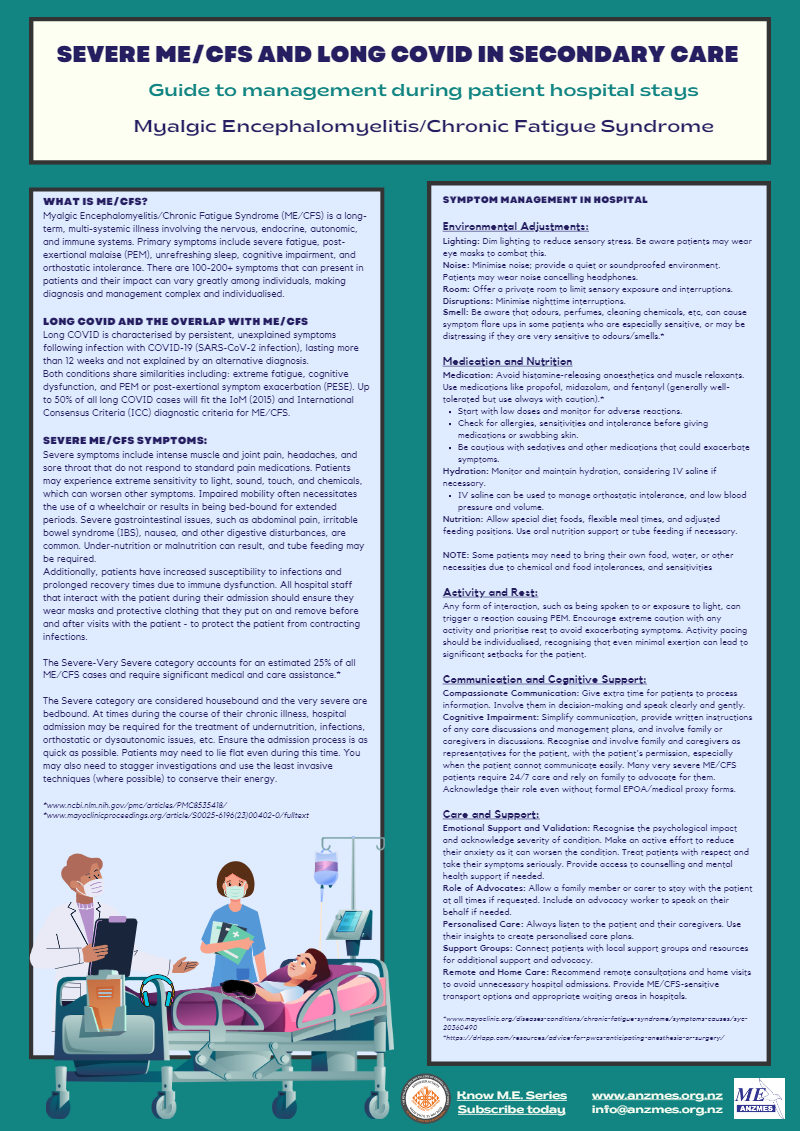
ANZMES Releases Essential Resource for Healthcare Professionals to Manage Hospital Stays of Severe ME/CFS and long COVID Patients

Press Release:

ANZMES (the National Advisory on ME/CFS and a RNZCGP registered provider of continuing education) has released a short reference guide for secondary care. The resource acts as a guide for healthcare professionals in managing hospital stays for patients suffering from severe-very severe Myalgic Encephalomyelitis/Chronic Fatigue Syndrome (ME/CFS) and long COVID (lC). It aims to improve patient care by addressing the unique needs and symptoms of patients with severe ME/CFS and lC during their hospital admissions.

“ME/CFS is a complex condition and its severity is often misunderstood by healthcare professionals. Severe patients are housebound. Very severe patients are bedbound, with very high needs requiring 24/7 care. Hospitalisation often occurs due to undernutrition, infections, and dysautonomic issues. Therefore, it is crucial that healthcare professionals have the knowledge to effectively manage patients during hospital admissions so as not to exacerbate their severe and debilitating symptoms,” says ANZMES president, Fiona Charlton.

“Our aim with this new resource is to provide a clear and concise reference guide for healthcare professionals to enhance patient care. While the assessment and evaluation of long COVID may differ from ME/CFS, the management of long COVID closely mirrors it, so we have leveraged our medical team’s expertise to develop a guide to support the effective care of these patients in a hospital setting.” She says.

The resource outlines essential strategies for managing severe symptoms, including intense muscle and joint pain, extreme sensitivity to light, sound, touch, and chemicals, impaired mobility often necessitating a wheelchair, severe gastrointestinal issues, and increased susceptibility to infections due to immune dysfunction.

“For very severe patients, a light touch of the arm can be interpreted by the body as pain. Bright light can cause post-exertional malaise. People with very severe ME/CFS and long COVID spend the majority of their lives in darkened rooms, wearing noise cancelling headphones and eye masks. They are unable to eat properly, or bathe and toilet themselves without full time carers, and it is often a family member who assumes this role.” The impact of this on everyone cannot be underestimated.

An overview of key recommendations include:

  • Sensory Adjustments: Dim lighting, minimise noise, and provide private rooms to reduce sensory stress.
  • Medication and Nutrition: Avoid histamine-releasing anaesthetics and muscle relaxants. Use medications like propofol, midazolam, and fentanyl with caution. Monitor hydration and consider IV saline for orthostatic intolerance.[1]
  • Activity and Rest: Recognise that even minimal interactions, such as being spoken to or exposure to light, can trigger PEM. Prioritise rest and avoid any unnecessary activity.
  • Communication and Cognitive Support: Involve family and caregivers as representatives, especially when the patient cannot communicate; or simplify communication by providing written instructions and allowing extra time for patients to process information.
  • Care and Support: Recognise the psychological impact, validate the severity of conditions, and provide access to counselling and mental health support. Include family members or caregivers in discussions and allow them to stay with the patient if requested.

ANZMES emphasises the importance of personalised care plans, the involvement of patient’s family members and their regular health team to understand the severity of their condition. The guide also encourages connections with local support groups and resources for additional advocacy and support for not only patients, but also their carers to avoid burnout. Remote consultations and home visits are recommended to avoid unnecessary hospital admissions.

ANZMES president, Fiona Charlton concludes “We believe that education is key to improving outcomes for patients with severe-very severe ME/CFS and long COVID. By providing this resource, we aim to enhance the knowledge and confidence of healthcare professionals so they are equipped when these patients are admitted under their care.”

Understanding ME/CFS and long COVID:

Myalgic Encephalomyelitis/Chronic Fatigue Syndrome (ME/CFS) is a long-term, multi-systemic illness affecting the nervous, endocrine, autonomic, and immune systems. Patients experience severe fatigue, post-exertional malaise (PEM), unrefreshing sleep, cognitive impairment, and orthostatic intolerance. With over 100-200+ potential symptoms, the condition’s impact can vary greatly, making diagnosis and management highly individualised. Roughly 25% of all ME/CFS cases are categorised as mild, 50% as moderate-severe and 25% as very severe.[2] [3]

Long COVID is characterised by persistent, unexplained symptoms following infection with COVID-19 (SARS-CoV-2) lasting more than 12 weeks and not explained by an alternative diagnosis. Both conditions share symptoms such as extreme fatigue, cognitive dysfunction, and post-exertional symptom exacerbation (PESE), with up to 50% of long COVID cases fitting the diagnostic criteria for ME/CFS.

Post-Exertional Malaise (PEM)

Post-Exertional Malaise (PEM), also referred to as post-exertional symptom exacerbation (PESE) in the context of long COVID, is a debilitating response to normal, every-day activities in people with ME/CFS. For individuals with severe-very severe ME/CFS or lC, this can be triggered by sensory overload, such as exposure to light or even simple conversations. Repeated episodes of PEM can exacerbate these already severe symptoms, and even minimal exertion can lead to significant setbacks for the patient’s health and wellbeing.

About ANZMES

ANZMES, the Associated New Zealand ME Society, is the National Advisory on ME/CFS. Established in 1980, ANZMES has been at the forefront of research, representation, and education for ME/CFS in Aotearoa/New Zealand. The organisation is a registered provider of continuing medical education with the Royal New Zealand College of General Practitioners (RNZCGP) and is dedicated to improving the lives of those affected by ME/CFS and long COVID. ANZMES is a founding member of the World ME Alliance.
 

Developing a clinical-pathological framework of long COVID-related fatigue applied to public safety workers

Abstract:

In the wake of the COVID-19 pandemic, millions worldwide are still struggling with persistent or recurring symptoms known as long COVID. Fatigue is one of the most prevalent symptoms associated with long COVID, and for many it can be debilitating. Understanding the potential pathological processes that link fatigue to long COVID is critical to better guide treatment. Challenges with diagnosis and treatment are reviewed, recognizing that post-COVID fatigue does not always present with corroborating clinical evidence, a situation that is frustrating for both patients and healthcare providers.

Firefighters are a group of public safety workers who are particularly impacted by long COVID-related fatigue. Firefighters must be able to engage in strenuous physical activity and deal with demanding psychological situations, both of which may be difficult for those suffering from fatigue. Disruption in public safety worker health can potentially impact community welfare. This review creates a framework to explain the clinical-pathological features of fatigue resulting from long COVID, addresses diagnosis and treatment challenges, and explores the unique impact fatigue may pose for public safety workers and their organizations.

Source: Lofrano-Porto A, D’Isabel S, Smith DL. Developing a clinical-pathological framework of long COVID-related fatigue applied to public safety workers. Front Med (Lausanne). 2024 Jul 17;11:1387499. doi: 10.3389/fmed.2024.1387499. PMID: 39086937; PMCID: PMC11288841. https://www.ncbi.nlm.nih.gov/pmc/articles/PMC11288841/ (Full text)

Brain microstructural changes and fatigue after COVID-19

Abstract:

Background: Fatigue and cognitive complaints are the most frequent persistent symptoms in patients after severe acute respiratory syndrome coronavirus 2 (SARS-CoV-2) infection. This study aimed to assess fatigue and neuropsychological performance and investigate changes in the thickness and volume of gray matter (GM) and microstructural abnormalities in the white matter (WM) in a group of patients with mild-to-moderate coronavirus disease 2019 (COVID-19).

Methods: We studied 56 COVID-19 patients and 37 matched controls using magnetic resonance imaging (MRI). Cognition was assessed using Montreal Cognitive Assessment and Cambridge Neuropsychological Test Automated Battery, and fatigue was assessed using Chalder Fatigue Scale (CFQ-11). T1-weighted MRI was used to assess GM thickness and volume. Fiber-specific apparent fiber density (FD), free water index, and diffusion tensor imaging data were extracted using diffusion-weighted MRI (d-MRI). d-MRI data were correlated with clinical and cognitive measures using partial correlations and general linear modeling.

Results: COVID-19 patients had mild-to-moderate acute illness (95% non-hospitalized). The average period between real-time quantitative reverse transcription polymerase chain reaction-based diagnosis and clinical/MRI assessments was 93.3 (±26.4) days. The COVID-19 group had higher total CFQ-11 scores than the control group (p < 0.001). There were no differences in neuropsychological performance between groups. The COVID-19 group had lower FD in the association, projection, and commissural tracts, but no change in GM. The corona radiata, corticospinal tract, corpus callosum, arcuate fasciculus, cingulate, fornix, inferior fronto-occipital fasciculus, inferior longitudinal fasciculus, superior longitudinal fasciculus, and uncinate fasciculus were involved. CFQ-11 scores, performance in reaction time, and visual memory tests correlated with microstructural changes in patients with COVID-19.

Conclusions: Quantitative d-MRI detected changes in the WM microstructure of patients recovering from COVID-19. This study suggests a possible brain substrate underlying the symptoms caused by SARS-CoV-2 during medium- to long-term recovery.

Source: Bispo DDC, Brandão PRP, Pereira DA, Maluf FB, Dias BA, Paranhos HR, von Glehn F, de Oliveira ACP, Regattieri NAT, Silva LS, Yasuda CL, Soares AASM, Descoteaux M. Brain microstructural changes and fatigue after COVID-19. Front Neurol. 2022 Nov 10;13:1029302. doi: 10.3389/fneur.2022.1029302. PMID: 36438956; PMCID: PMC9685991. https://www.ncbi.nlm.nih.gov/pmc/articles/PMC9685991/ (Full text)

Sleep and circadian rhythm alterations in myalgic encephalomyelitis/chronic fatigue syndrome and post-COVID fatigue syndrome and its association with cardiovascular risk factors: A prospective cohort study

Abstract:

This study aimed to investigate circadian rhythm manifestations in Myalgic Encephalomyelitis/Chronic Fatigue Syndrome (ME/CFS) patients (including a subpopulation of long-COVID patients) and matched healthy controls while also exploring their association with cardiovascular health variables.

Thirty-one ME/CFS patients (75% females), 23 individuals diagnosed with post-COVID ME/CFS (56% females) and 31 matched healthy controls (68% females) were enrolled in this study. Demographic and clinical characteristics were assessed using validated self-reported outcome measures. Actigraphy data, collected over one week, were used to analyze the 24-h profiles of wrist temperature, motor activity, and sleep circadian variables in the study participants. Associations between lipid profile with endothelial dysfunction biomarkers (such as endothelin-1, ICAM-1 and VCAM-1) and with sleep and circadian variables were also studied.

No differences were found in these variables between the two group of patients. Patients showed lower activity and worse sleep quality than matched healthy controls, together with a worse lipid profile than controls, that was associated with disturbances in the circadian temperature rhythm. ICAM-1 levels were associated with plasma lipids in healthy controls, but not in patients, who showed higher levels of endothelin-1 and VCAM-1.

These findings suggest that lipid profiles in ME/CFS are linked to disrupted circadian rhythms and sleep patterns, likely due to endothelial dysfunction. Furthermore, they highlight the intricate relationship between sleep, circadian rhythms, and cardiovascular health in this condition.

Source: Zerón-Rugerio MF, Zaragozá MC, Domingo JC, Sanmartín-Sentañes R, Alegre-Martin J, Castro-Marrero J, Cambras T. Sleep and circadian rhythm alterations in myalgic encephalomyelitis/chronic fatigue syndrome and post-COVID fatigue syndrome and its association with cardiovascular risk factors: A prospective cohort study. Chronobiol Int. 2024 Jul 22:1-12. doi: 10.1080/07420528.2024.2380020. Epub ahead of print. PMID: 39037125. https://pubmed.ncbi.nlm.nih.gov/39037125/

Long COVID as a Disease of Accelerated Biological Aging: An Opportunity to Translate Geroscience Interventions

Abstract:

It has been four years since long COVID-the protracted consequences that survivors of COVID-19 face-was first described. Yet, this entity continues to devastate the quality of life of an increasing number of COVID-19 survivors without any approved therapy. Furthermore, there remains a paucity of clinical trials addressing the biological root causes of this disease. Notably, the symptoms of long COVID-including but not limited to exercise intolerance, cognitive impairment, orthostasis, and functional decline-are typically seen with advancing age.

Leveraging this similarity, we posit that Geroscience-which aims to target the biological drivers of aging to prevent age-associated conditions as a group-could offer promising therapeutic avenues for long COVID. Bearing this in mind, this review presents a framework for studying long COVID as a state of effectively accelerated biological aging. Thus, we comprehensively review here the role of biological hallmarks of aging in long COVID, identifying research gaps and proposing directions for future preclinical and clinical studies.

Source: Shafqat A, Masters MC, Tripathi U, Tchkonia T, Kirkland JL, Hashmi SK. Long COVID as a Disease of Accelerated Biological Aging: An Opportunity to Translate Geroscience Interventions. Ageing Res Rev. 2024 Jun 28:102400. doi: 10.1016/j.arr.2024.102400. Epub ahead of print. PMID: 38945306. https://www.sciencedirect.com/science/article/abs/pii/S1568163724002186

Illness presentation and quality of life in myalgic encephalomyelitis/chronic fatigue syndrome and post COVID-19 condition: a pilot Australian cross-sectional study

Abstract:

Purpose: Post COVID-19 Condition (PCC), being persistent COVID-19 symptoms, is reminiscent of Myalgic Encephalomyelitis/Chronic Fatigue Syndrome (ME/CFS)-a chronic multi-systemic illness characterised by neurocognitive, autonomic, endocrinological and immunological disturbances. This novel cross-sectional investigation aims to: (1) compare symptoms among people with ME/CFS (pwME/CFS) and people with PCC (pwPCC) to inform developing PCC diagnostic criteria; and (2) compare health outcomes between patients and people without acute or chronic illness (controls) to highlight the illness burdens of ME/CFS and PCC.

Methods: Sociodemographic and health outcome data were collected from n = 61 pwME/CFS, n = 31 pwPCC and n = 54 controls via validated, self-administered questionnaires, including the 36-Item Short-Form Health Survey version 2 (SF-36v2) and World Health Organization Disability Assessment Schedule version 2.0 (WHODAS 2.0). PwME/CFS and pwPCC also provided self-reported severity and frequency of symptoms derived from the Canadian and International Consensus Criteria for ME/CFS and the World Health Organization case definition for PCC.

Results: Both illness cohorts similarly experienced key ME/CFS symptoms. Few differences in symptoms were observed, with memory disturbances, muscle weakness, lymphadenopathy and nausea more prevalent, light-headedness more severe, unrefreshed sleep more frequent, and heart palpitations less frequent among pwME/CFS (all p < 0.05). The ME/CFS and PCC participants’ SF-36v2 or WHODAS 2.0 scores were comparable (all p > 0.05); however, both cohorts returned significantly lower scores in all SF-36v2 and WHODAS 2.0 domains when compared with controls (all p < 0.001).

Conclusion: This Australian-first investigation demonstrates the congruent and debilitating nature of ME/CFS and PCC, thereby emphasising the need for multidisciplinary care to maximise patient health outcomes.

Source: Weigel B, Eaton-Fitch N, Thapaliya K, Marshall-Gradisnik S. Illness presentation and quality of life in myalgic encephalomyelitis/chronic fatigue syndrome and post COVID-19 condition: a pilot Australian cross-sectional study. Qual Life Res. 2024 Jul 3. doi: 10.1007/s11136-024-03710-3. Epub ahead of print. PMID: 38961009. https://link.springer.com/article/10.1007/s11136-024-03710-3 (Full text)

Flow Clotometry: Measuring Amyloid Microclots in ME/CFS, Long COVID, and Healthy Samples with Imaging Flow Cytometry

Abstract:

Myalgic encephalomyelitis/chronic fatigue syndrome (ME/CFS) has received more attention since the characterization of Long COVID (LC), a condition somewhat similar in symptom presentation and, to some extent, pathophysiological mechanisms. A prominent feature of LC pathology is amyloid, fibrinolysis-resistant fibrin(ogen) fragments, termed microclots. Despite prior identification of microclots in ME/CFS, quantitative analysis has remained challenging due to the reliance on representative micrographs and software processing for estimations.

Addressing this gap, the present study uses a cell-free imaging flow cytometry approach, optimized for the quantitative analysis of Thioflavin T-stained microclots, to precisely measure microclot concentration and size distribution across ME/CFS, LC, and healthy cohorts. We refer to our cell-free flow cytometry technique for detecting microclots as ‘flow clotometry’.

We demonstrate significant microclot prevalence in ME/CFS and LC, with LC patients exhibiting the highest concentration (18- and 3-fold greater than the healthy and ME/CFS groups, respectively). This finding underscores a common pathology across both conditions, emphasizing a dysregulated coagulation system. Moreover, relating to microclot size distribution, the ME/CFS group exhibited a significantly higher prevalence across all area ranges when compared to the controls, but demonstrated a significant difference for only a single area range when compared to the LC group.

This suggests a partially overlapping microclot profile in ME/CFS relative to LC, despite the overall higher concentration in the latter. The present study paves the way for prospective clinical application that aims to efficiently detect, measure and treat microclots.

Source: Etheresia Pretorius, Massimo Nunes, Jan pretorius et al. Flow Clotometry: Measuring Amyloid Microclots in ME/CFS, Long COVID, and Healthy Samples with Imaging Flow Cytometry, 24 June 2024, PREPRINT (Version 1) available at Research Square [https://doi.org/10.21203/rs.3.rs-4507472/v1] https://www.researchsquare.com/article/rs-4507472/v1 (Full text)

Reduction of long COVID symptoms after stellate ganglion block: A retrospective chart review study

Abstract:

The SARS-CoV-2 pandemic has left millions of individuals with a host of post-viral symptoms that can be debilitating and persist indefinitely. To date there are no definitive tests or treatments for the collection of symptoms known as “Long COVID” or Post-acute sequelae of COVID-19 (PASC). Following our initial case report detailing improvement of Long COVID symptoms after sequential bilateral stellate ganglion blockade (SGB), we performed a retrospective chart analysis study on individuals treated with the same protocol over the course of six months (2021-2022) in our clinic.

Patients self-reported symptoms on a 10-point scale as part of optional patient follow-up using an online survey. After one month or more following treatment, patients reported striking reductions in Fatigue, Worsening of Symptoms following Mental and Physical Activity, Memory Problems, Problems Concentrating, Sleep Problems, Anxiety, and Depression. Loss of Taste and Loss of Smell in some individuals did not respond to treatment, likely indicating structural damage following infection.

This study suggests that neuromodulation may provide relief of Long COVID symptoms for at least a subset of individuals, and provides support for prospective studies of this potential treatment.

Source: Duricka D, Liu L. Reduction of long COVID symptoms after stellate ganglion block: A retrospective chart review study. Auton Neurosci. 2024 Jun 13;254:103195. doi: 10.1016/j.autneu.2024.103195. Epub ahead of print. PMID: 38901177. https://www.autonomicneuroscience.com/article/S1566-0702(24)00049-3/fulltext (Full text)

Systems Modeling Reveals Shared Metabolic Dysregulation and Novel Therapeutic Treatments in ME/CFS and Long COVID

Abstract:

Myalgic Encephalomyelitis/Chronic Fatigue Syndrome (ME/CFS) and Long COVID are complex, multisystemic conditions that pose ongoing challenges to healthcare professionals. Emerging research suggests that ME/CFS and Long COVID exhibit overlapping metabolic symptoms, indicating possible shared metabolic dysfunctions. This study aims to systematically explore these shared metabolic disturbances and their potential treatments.

Utilizing our novel metabolic modeling method, GPMM, we identified the key metabolic irregularities in patients with ME/CFS and Long COVID, notably the downregulation of the alanine and aspartate metabolism pathway, and the arginine and proline metabolism pathway.

Genome-wide knockout analyses indicated that supplementation with aspartate (ASP) or asparagine (ASN) could potentially ameliorate these metabolic deficiencies. Further metabolic assessments in Long COVID patients highlighted the significant downregulation of ASP in both blood and muscle, supporting our predictions.

Consequently, we propose that the combination of l-ornithine and l-aspartate (LOLA) offers a promising approach to alleviate metabolic symptoms in both ME/CFS and Long COVID patients. This study not only elucidates the shared metabolic pathways in ME/CFS and Long COVID but also positions LOLA as a viable candidate for future clinical trials.

Source: Gong-Hua LiFeifei HanQing-Peng KongWenzhong Xiao. Systems Modeling Reveals Shared Metabolic Dysregulation and Novel Therapeutic Treatments in ME/CFS and Long COVID.