A Perspective on Observation as Intervention in Chronic Diagnostic Complexity

Abstract:

This patient perspective article advances observation as an intentional, rigorous form of clinical care rather than a passive absence of intervention. The recommendations arise from the lived experience of Myalgic Encephalomyelitis/Chronic Fatigue Syndrome (ME/CFS), informed by clinical training as a mobile equine veterinarian.

Over a nine-year diagnostic course, early clinical curiosity gave way to prolonged skepticism in the context of normal examinations and laboratory findings, ultimately shifting responsibility for daily functioning and symptom interpretation onto the patient. Across repeated encounters, subtle but consistent indicators of impaired energy regulation and exertional intolerance were present yet remained clinically unintegrated. When viewed longitudinally, these findings revealed a coherent physiological pattern that was not apparent at any single time point.

Modern medical training emphasizes action. However complex, relapsing, and poorly understood conditions often demand sustained clinical attention before diagnostic clarity emerges. In the absence of immediate abnormalities, discomfort with uncertainty may prompt premature intervention or disengagement, eroding trust and obscuring evolving signals.

Structured observation offers an alternative. As a clinical strategy, it preserves diagnostic curiosity, strengthens the physician-patient relationship, and allows for the observation of physiology without confounding influences. Such observation can yield meaningful insight and guide precise, compassionate care.

Source: Niederman CN. A Perspective on Observation as Intervention in Chronic Diagnostic Complexity. J Patient Exp. 2026 May 11;13:23743735261449971. doi: 10.1177/23743735261449971. PMID: 42137851; PMCID: PMC13168711. https://pmc.ncbi.nlm.nih.gov/articles/PMC13168711/ (Full text)

Long COVID: a long road ahead

Abstract:

The SARS-CoV-2 pandemic caused an estimated 400 million people worldwide to experience Long COVID and post-COVID complications leading to significant chronic illness and disability with its devastating physical, societal and economic consequences. Since post-acute infectious syndromes have not been given adequate consideration prior to the pandemic, many millions of people with Long COVID worldwide have been left disabled as currently available therapies are largely symptomatic and only partially effective.

A case of a previously healthy woman with Long COVID and post-COVID autonomic dysfunction and myalgic encephalomyelitis/chronic fatigue syndrome (ME/CFS) is presented here from the perspective of a physician-patient relationship and a broader context of medical care and public health. Immunologic and autonomic mechanistic factors and therapies as these relate to Long COVID are highlighted.

Complexities and issues pertaining to patient care, public health and education of neurologists and other specialists regarding Long COVID, dysautonomia and ME/CFS diagnosis and treatment are discussed, in conjunction with the need to develop and diversify effective therapies for people living with these highly disabling conditions.

Source: Blitshteyn S. Long COVID: a long road ahead. Oxf Open Immunol. 2025 Dec 13;6(1):iqaf010. doi: 10.1093/oxfimm/iqaf010. PMID: 41426345; PMCID: PMC12718103. https://pmc.ncbi.nlm.nih.gov/articles/PMC12718103/ Full text)

Reframing Myalgic Encephalomyelitis/Chronic Fatigue Syndrome (ME/CFS): Biological Basis of Disease and Recommendations for Supporting Patients

Abstract:

Myalgic Encephalomyelitis/Chronic Fatigue Syndrome (ME/CFS) is a worldwide challenge. There are an estimated 17-24 million patients worldwide, with an estimated 60 percent or more who have not been diagnosed. Without a known cure, no specific curative medication, disability lasting years to being life-long, and disagreement among healthcare providers as to how to most appropriately treat these patients, ME/CFS patients are in need of assistance. Appropriate healthcare provider education would increase the percentage of patients diagnosed and treated; however, in-school healthcare provider education is limited.

To address the latter issue, the New Jersey Myalgic Encephalomyelitis/Chronic Fatigue Syndrome Association (NJME/CFSA) has developed an independent, incentive-driven, learning program for students of the health professions. NJME/CFSA offers a yearly scholarship program in which applicants write a scholarly paper on an ME/CFS-related topic. The efficacy of the program is demonstrated by the 2024-2025 first place scholarship winner’s essay, which addresses the biological basis of ME/CFS and how the healthcare provider can improve the quality of life of ME/CFS patients.

For the reader, the essay provides an update on what is known regarding the biological underpinnings of ME/CFS, as well as a medical student’s perspective as to how the clinician can provide care and support for ME/CFS patients. The original essay has been slightly modified to demonstrate that ME/CFS is a worldwide problem and for publication.

Source: Agarwal P, Friedman KJ. Reframing Myalgic Encephalomyelitis/Chronic Fatigue Syndrome (ME/CFS): Biological Basis of Disease and Recommendations for Supporting Patients. Healthcare (Basel). 2025 Aug 5;13(15):1917. doi: 10.3390/healthcare13151917. PMID: 40805949. https://www.mdpi.com/2227-9032/13/15/1917 (Full text)

Pediatric Myalgic Encephalomyelitis/Chronic Fatigue Syndrome (ME/CFS): A Diagnostic and Communication Case Study for Health Care Providers in Training

Abstract:

Introduction: Myalgic encephalomyelitis/chronic fatigue syndrome (ME/CFS) is a chronic, complex illness. No diagnostic tests exist; illness evaluation relies on medical history, physical exam, and laboratory tests. While more is known about ME/CFS in adults, it can affect children and adolescents as a chronic condition.

Methods: We implemented an ME/CFS pediatric educational activity (diagnosis, management, and communication) with medical, physician assistant, and nursing students at one university and with medical students at a second university. Pretests, two videos and slides, and posttests were completed in approximately 40 minutes. Evaluation included quantitative and qualitative measures for knowledge, attitudes, beliefs, confidence, and clinical information about ME/CFS.

Results: The first group included 31 students who reported low familiarity and clinical exposure to ME/CFS. At posttest, 25 students (81%) recognized ME/CFS as a medical condition compared to seven (23%) at pretest. Using 0-5 scales, mean pretest-to-posttest ability to diagnose increased from 1.0 to 3.5, and confidence to communicate increased from 1.4 to 3.9. The second group, including 26 students pretest and 19 posttest, also reported low familiarity and clinical exposure The posttest showed increased self-rated ability to diagnose (pretest M: 0.6, posttest M: 3.3) and confidence to communicate (pretest M: 1.4, posttest M: 3.7). Qualitative feedback for this group showed understanding of pediatric ME/CFS symptoms, management, and communication.

Discussion: This educational activity increased knowledge of ME/CFS as self-reported ability to make a diagnosis and increased confidence to communicate about pediatric ME/CFS. Participating students showed changes in attitudes towards ME/CFS as a medical condition.

Source: Brimmer DJ, Lin JS, Selinger HA, Issa A, Fall EA, Unger ER. Pediatric Myalgic Encephalomyelitis/Chronic Fatigue Syndrome (ME/CFS): A Diagnostic and Communication Case Study for Health Care Providers in Training. MedEdPORTAL. 2025 Mar 14;21:11507. doi: 10.15766/mep_2374-8265.11507. PMID: 40092054; PMCID: PMC11906784. https://pmc.ncbi.nlm.nih.gov/articles/PMC11906784/ (Full text)

Managing Energy, and Shaping Care: Insights from Adults with Myalgic Encephalomyelitis/Chronic Fatigue Syndrome Through Co-Production Workshops

Abstract:

Background: Myalgic Encephalomyelitis/Chronic Fatigue Syndrome (ME/CFS) is a complex, debilitating condition characterised by severe fatigue that is not relieved by rest and is often exacerbated by physical or mental activity. A key challenge for individuals with ME/CFS is energy management and to date, the only recommended strategy is “activity pacing.” This approach involves balancing activity and rest to avoid overexertion and minimise the risk of symptom exacerbation, commonly known as “post-exertional malaise”(PEM). A recent systematic review highlighted significant shortcomings in activity pacing interventions for ME/CFS, noting that they lacked rigour, were brief, and did not follow guidelines or integrate recommended technology, limiting their relevance for modern energy management. To address these gaps, the present study aimed to explore ME/CFS patients’ and health practitioners’ perspectives on approaches to energy management, how their understanding of energy management has evolved over time, and their recommendations for future interventions concerning energy management.

Method: Eight individuals with ME/CFS participated in six one-hour long online co-production workshops with two researchers, with the option to provide input through written responses. Additionally, three health practitioners shared their perspectives via email. Thematic analysis of the data identified several key recommendations for improving ME/CFS care.

Results and conclusions: Workshops highlighted the need for early support, healthcare provider training, and public education to combat stigma and misconceptions around ME/CFS. Participants emphasised patient collaboration, research-informed practices, rigorous research, multidisciplinary teams, and the integration of technologies like mHealth, along with a comprehensive approach including sleep, diet, and psychological support for better symptom management and activity pacing.

Source: Thornton EJ, Hayes LD, Goodwin DS, Sculthorpe N, Prior Y, Sanal-Hayes NEM. Managing Energy, and Shaping Care: Insights from Adults with Myalgic Encephalomyelitis/Chronic Fatigue Syndrome Through Co-Production Workshops. Am J Med. 2025 Feb 15:S0002-9343(25)00093-2. doi: 10.1016/j.amjmed.2025.02.008. Epub ahead of print. PMID: 39961545. https://www.amjmed.com/article/S0002-9343(25)00093-2/fulltext (Full text)

Language Matters: What Not to Say to Patients with Long COVID, Myalgic Encephalomyelitis/Chronic Fatigue Syndrome, and Other Complex Chronic Disorders

Abstract:

People with Long COVID, myalgic encephalomyelitis/chronic fatigue syndrome (ME/CFS), and other complex chronic disorders consistently report having difficulty obtaining effective and compassionate medical care and being disbelieved, judged, gaslighted, and even dismissed by healthcare professionals. We believe that these adversarial interactions and language are more likely to arise when healthcare professionals are confronting complex chronic illnesses without proper training, diagnostic biomarkers, or FDA-approved therapies.
These problematic conversations between practitioners and patients often involve specific words and phrases—termed the “never-words”—can leave patients in significant emotional distress and negatively impact the clinician–patient relationship and recovery. Seeking to prevent these destructive interactions, we review key literature on best practices for difficult clinical conversations and discuss the application of these practices for people with Long COVID, ME/CFS, dysautonomia, and other complex chronic disorders. We provide recommendations for alternative, preferred phrasing to the never-words, which can enhance therapeutic relationship and chronic illness patient care via compassionate, encouraging, and non-judgmental language.
Source: Smyth NJ, Blitshteyn S. Language Matters: What Not to Say to Patients with Long COVID, Myalgic Encephalomyelitis/Chronic Fatigue Syndrome, and Other Complex Chronic Disorders. International Journal of Environmental Research and Public Health. 2025; 22(2):275. https://doi.org/10.3390/ijerph22020275 https://www.mdpi.com/1660-4601/22/2/275 (Full text)

Re-visiting professional ethics in psychotherapy: reflections on the use of talking therapies as a supportive adjunct for myalgic encephalomyelitis/chronic fatigue syndrome and ‘medically unexplained symptoms’

Abstract:

Following years of debate over the effectiveness of cognitive behavioural therapy for myalgic encephalomyelitis/chronic fatigue syndrome (ME/CFS), public health bodies in the UK and beyond have determined that no psychotherapy is clinically proven for this patient group. In the field of ME/CFS and the wider arena of ‘medically unexplained symptoms’ (MUS), patient survey data and qualitative research capturing patient experiences and psychotherapist attitudes suggest that therapeutic practice may sometimes fall short of required ethical standards. This raises questions about how psychotherapists can safely support, as opposed to treat, people with these debilitating conditions.

We consider four ethical principles that feature throughout psychotherapists’ codes of practice, those of respect, competence, responsibility and integrity, and discuss examples of good and poor practice in this arena as evinced by recent empirical literature.

Following this, we offer a variety of suggestions to help strengthen ethical psychotherapy practice with patients with ME/CFS and other MUS. In terms of practitioner education, we recommend greater emphasis on humility, reflexivity and disability-affirming practices, exploration of personal as well professional ethics, and integration of patient expertise-by-experience, accompanied with the latest evidence, into foundational and ongoing training.

In terms of ongoing practice, we suggest consideration of formalised patient-focused feedback systems and greater transparency vis-à-vis patient access to clinical notes. Finally, we underline the importance of elevating patients from mere subjects to co-producers of psychotherapy research.

Source: Hunt J, Blease C. Re-visiting professional ethics in psychotherapy: reflections on the use of talking therapies as a supportive adjunct for myalgic encephalomyelitis/chronic fatigue syndrome and ‘medically unexplained symptoms’. J Med Ethics. 2024 Dec 31:jme-2023-109627. doi: 10.1136/jme-2023-109627. Epub ahead of print. PMID: 39740979. https://jme.bmj.com/content/early/2024/12/31/jme-2023-109627 (Full text)

Development and Implementation of an Online Patient Education Program for Children and Adolescents With Myalgic Encephalomyelitis/Chronic Fatigue Syndrome, Their Parents, Siblings, and School Personnel: Protocol for the Prospective BAYNET FOR ME/CFS Study

Abstract:

Background: Myalgic encephalomyelitis/chronic fatigue syndrome (ME/CFS) presents significant challenges for affected children and adolescents, their social environment, and treating physicians, due to its profound impact on quality of life and the lack of causal therapeutic approaches. One crucial aspect of care that has been missing for these patients is comprehensive education for both them and their social circles.

Objective: This study protocol aims to outline the goals, study design, execution, and evaluation of the subproject within the BAYNET FOR ME/CFS project. The focus is on developing online education programs for children and adolescents with ME/CFS, as well as for their parents, siblings, and school staff. These programs are designed to improve independent disease management, increase knowledge, and promote interaction with other affected individuals.

Methods: In phase I, the group-based online education programs were developed by a multidisciplinary team based on the ModuS concept created by the Competence Network for Patient Education (KomPaS). These programs were then piloted and finalized. Phase II involved recruiting participants and implementing the finalized programs. Given the restricted physical and cognitive capacities of the affected individuals, the patient education programs were exclusively designed in a digital format to facilitate participation. In phase III, the programs will be evaluated for acceptance, completeness, and participant satisfaction. The qualitative assessment will focus on individual expectations and benefits derived from the training. Phase IV will further assess the programs in terms of improvements in disease knowledge, health-related quality of life, life satisfaction, and family burden.

Results: The programs were developed, piloted, and finalized during phase I, which ran from December 2022 to May 2023. The pilot phase, from March to May 2023, led to adaptations in the program concept. In total, 8 patients and their parents, 5 siblings, and 59 school staff participated in the piloting. Adjustments were made to the format, content, duration, and schedule to better meet the needs of the affected individuals and their social circles. In phase II, participant recruitment for the patient education program took place from January to July 2023. The study successfully recruited 24 young patients with ME/CFS and their parents, along with 8 siblings and 51 school staff. Two program blocks for patients and parents and 2-3 blocks for siblings and school staff commenced in May 2023 and were completed within the same year. Phase III began after phase II and involves the evaluation of the programs, with the process expected to conclude by the end of 2024. Phase IV, planned for 2025-2026, will involve the rollout of the program to 150 children and their caretakers. This phase will focus on evaluating disease knowledge, health-related quality of life, life satisfaction, and family burden, as well as include longitudinal assessments.

Conclusions: The data aim to support the development of a comprehensive, interprofessional care model for children and adolescents with ME/CFS.

Source: Keicher F, Thomann J, Erlenwein J, Schottdorf M, Reiter NL, Scholz-Schwärzler NP, Vogel B, Warlitz C, Stojanov S, Augustin S, Goldbrunner L, Schanz L, Dodel V, Zipper C, Schiweck N, Jaeschke R, Saramandic M, Wiejaczka K, Eberhartinger M, Dettmer K, Hattesohl DBR, Englbrecht S, Behrends U, Spiegler J. Development and Implementation of an Online Patient Education Program for Children and Adolescents With Myalgic Encephalomyelitis/Chronic Fatigue Syndrome, Their Parents, Siblings, and School Personnel: Protocol for the Prospective BAYNET FOR ME/CFS Study. JMIR Res Protoc. 2024 Nov 21;13:e54679. doi: 10.2196/54679. PMID: 39570662. https://www.researchprotocols.org/2024/1/e54679 (Full text)

Virtual reality education on myalgic encephalomyelitis for medical students and healthcare professionals: a pilot study

Abstract:

Introduction: Myalgic encephalomyelitis/ chronic fatigue syndrome (ME/CFS) is a chronic condition which may be characterised by debilitating fatigue, post-exertional malaise, unrefreshing sleep, and cognitive difficulties. ME/CFS has significant negative impact on quality of life for those living with the condition. This may be exacerbated by a lack of knowledge within healthcare regarding the condition. Previous research has found that immersive virtual reality (VR) educational experiences within healthcare education can increase knowledge and empathy.

Methods: The present study employed a quasi-experimental pre-test-post-test design to investigate the impact of a short immersive VR educational experience on knowledge of ME/CFS and empathy for those living with the condition. The VR experience placed participants into a virtual scene which told real life stories of the experience of people living with ME/CFS and their families. 43 participants completed in this pilot study: 28 medical students and 15 primary care health professionals. Participants completed measures of knowledge of ME/CFS and empathy before and after engagement with the experience.

Results: A statistically significant increase was found for levels of knowledge (p < .001, d = 0.74) and empathy (p < .001, d = 1.56) from pre-VR experience levels to post-VR experience levels with a medium and large effect size, respectively. Further analysis revealed no statistically significant difference between baseline levels of knowledge of ME/CFS between healthcare professionals and medical students.

Discussion: The present study is the first to explore the use of this short immersive VR experience as an education tool within healthcare to increase knowledge of ME/CFS, and empathy for those living with the condition. Findings allude to the previously established lack of knowledge of ME/CFS within healthcare although promisingly the increases in knowledge and empathy found suggest that this immersive VR experience has potential to address this. Such changes found in this small-scale pilot study suggest that future research into the use of VR as an educational tool within this setting may be beneficial. Use of a control group, and larger sample size as well as investigation of retention of these changes may also enhance future research.

Source: Anderson T, Duffy G, Corry D. Virtual reality education on myalgic encephalomyelitis for medical students and healthcare professionals: a pilot study. BMC Med Educ. 2024 Sep 17;24(1):1018. doi: 10.1186/s12909-024-05990-2. PMID: 39289650; PMCID: PMC11409778. https://www.ncbi.nlm.nih.gov/pmc/articles/PMC11409778/ (Full text)

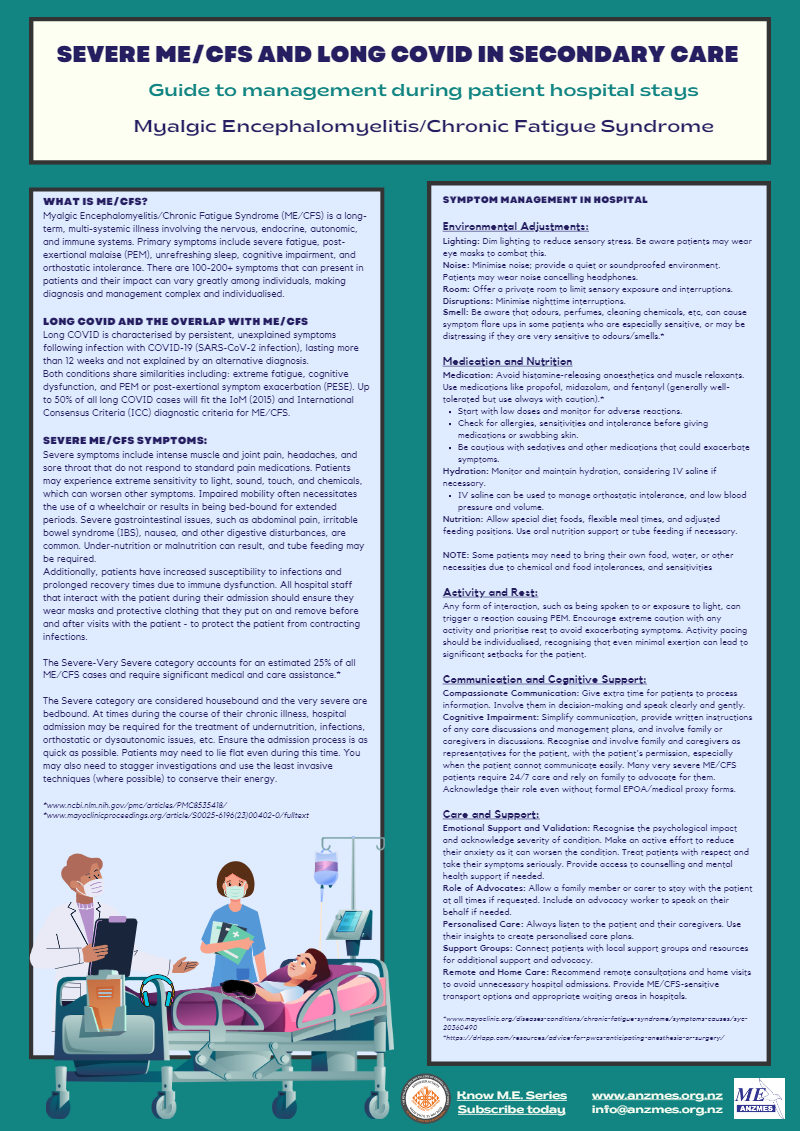
ANZMES Releases Essential Resource for Healthcare Professionals to Manage Hospital Stays of Severe ME/CFS and long COVID Patients

Press Release:

ANZMES (the National Advisory on ME/CFS and a RNZCGP registered provider of continuing education) has released a short reference guide for secondary care. The resource acts as a guide for healthcare professionals in managing hospital stays for patients suffering from severe-very severe Myalgic Encephalomyelitis/Chronic Fatigue Syndrome (ME/CFS) and long COVID (lC). It aims to improve patient care by addressing the unique needs and symptoms of patients with severe ME/CFS and lC during their hospital admissions.

“ME/CFS is a complex condition and its severity is often misunderstood by healthcare professionals. Severe patients are housebound. Very severe patients are bedbound, with very high needs requiring 24/7 care. Hospitalisation often occurs due to undernutrition, infections, and dysautonomic issues. Therefore, it is crucial that healthcare professionals have the knowledge to effectively manage patients during hospital admissions so as not to exacerbate their severe and debilitating symptoms,” says ANZMES president, Fiona Charlton.

“Our aim with this new resource is to provide a clear and concise reference guide for healthcare professionals to enhance patient care. While the assessment and evaluation of long COVID may differ from ME/CFS, the management of long COVID closely mirrors it, so we have leveraged our medical team’s expertise to develop a guide to support the effective care of these patients in a hospital setting.” She says.

The resource outlines essential strategies for managing severe symptoms, including intense muscle and joint pain, extreme sensitivity to light, sound, touch, and chemicals, impaired mobility often necessitating a wheelchair, severe gastrointestinal issues, and increased susceptibility to infections due to immune dysfunction.

“For very severe patients, a light touch of the arm can be interpreted by the body as pain. Bright light can cause post-exertional malaise. People with very severe ME/CFS and long COVID spend the majority of their lives in darkened rooms, wearing noise cancelling headphones and eye masks. They are unable to eat properly, or bathe and toilet themselves without full time carers, and it is often a family member who assumes this role.” The impact of this on everyone cannot be underestimated.

An overview of key recommendations include:

  • Sensory Adjustments: Dim lighting, minimise noise, and provide private rooms to reduce sensory stress.
  • Medication and Nutrition: Avoid histamine-releasing anaesthetics and muscle relaxants. Use medications like propofol, midazolam, and fentanyl with caution. Monitor hydration and consider IV saline for orthostatic intolerance.[1]
  • Activity and Rest: Recognise that even minimal interactions, such as being spoken to or exposure to light, can trigger PEM. Prioritise rest and avoid any unnecessary activity.
  • Communication and Cognitive Support: Involve family and caregivers as representatives, especially when the patient cannot communicate; or simplify communication by providing written instructions and allowing extra time for patients to process information.
  • Care and Support: Recognise the psychological impact, validate the severity of conditions, and provide access to counselling and mental health support. Include family members or caregivers in discussions and allow them to stay with the patient if requested.

ANZMES emphasises the importance of personalised care plans, the involvement of patient’s family members and their regular health team to understand the severity of their condition. The guide also encourages connections with local support groups and resources for additional advocacy and support for not only patients, but also their carers to avoid burnout. Remote consultations and home visits are recommended to avoid unnecessary hospital admissions.

ANZMES president, Fiona Charlton concludes “We believe that education is key to improving outcomes for patients with severe-very severe ME/CFS and long COVID. By providing this resource, we aim to enhance the knowledge and confidence of healthcare professionals so they are equipped when these patients are admitted under their care.”

Understanding ME/CFS and long COVID:

Myalgic Encephalomyelitis/Chronic Fatigue Syndrome (ME/CFS) is a long-term, multi-systemic illness affecting the nervous, endocrine, autonomic, and immune systems. Patients experience severe fatigue, post-exertional malaise (PEM), unrefreshing sleep, cognitive impairment, and orthostatic intolerance. With over 100-200+ potential symptoms, the condition’s impact can vary greatly, making diagnosis and management highly individualised. Roughly 25% of all ME/CFS cases are categorised as mild, 50% as moderate-severe and 25% as very severe.[2] [3]

Long COVID is characterised by persistent, unexplained symptoms following infection with COVID-19 (SARS-CoV-2) lasting more than 12 weeks and not explained by an alternative diagnosis. Both conditions share symptoms such as extreme fatigue, cognitive dysfunction, and post-exertional symptom exacerbation (PESE), with up to 50% of long COVID cases fitting the diagnostic criteria for ME/CFS.

Post-Exertional Malaise (PEM)

Post-Exertional Malaise (PEM), also referred to as post-exertional symptom exacerbation (PESE) in the context of long COVID, is a debilitating response to normal, every-day activities in people with ME/CFS. For individuals with severe-very severe ME/CFS or lC, this can be triggered by sensory overload, such as exposure to light or even simple conversations. Repeated episodes of PEM can exacerbate these already severe symptoms, and even minimal exertion can lead to significant setbacks for the patient’s health and wellbeing.

About ANZMES

ANZMES, the Associated New Zealand ME Society, is the National Advisory on ME/CFS. Established in 1980, ANZMES has been at the forefront of research, representation, and education for ME/CFS in Aotearoa/New Zealand. The organisation is a registered provider of continuing medical education with the Royal New Zealand College of General Practitioners (RNZCGP) and is dedicated to improving the lives of those affected by ME/CFS and long COVID. ANZMES is a founding member of the World ME Alliance.